Inherited libraries tend to arrive at the worst possible moment: during a house clearance, with a deadline, and with several family members who each remember a different book. The instinct is to box everything up or give it all away. Both are hard to undo.
A catalogue buys you time. Once the books are on a list, you can decide calmly, share the decision with the family, and check which ones are worth more than their shelf space.
1. Photograph everything first
Before you move a single book, photograph every shelf as it stands. It takes ten minutes and it preserves something you cannot recreate later: how the collection was arranged. Many families find those photos meaningful in their own right. And if you use an app that recognises books from a shelf photo, those same photos become your first draft of the catalogue.
2. Catalogue shelf by shelf
Work through the collection one shelf at a time, and do not sort while you catalogue; those are two separate jobs. For each shelf:
- Photograph the shelf, or scan the barcodes of the modern books.
- For older books without an ISBN, photograph the copyright page. It records the publisher, year and edition.
- Note anything unusual: dedications, signatures, bookplates, notes in the margins, loose letters or photos tucked inside.
3. Share the list with the family
This is where a catalogue earns its keep. Instead of a family WhatsApp group full of blurry photos, send everyone one list, as a link or a PDF, and let each person mark what they would like. It turns an emotional negotiation into a simple one, and nobody later discovers that the book they cared about went to a charity shop.
4. Find out what the books are worth
Most inherited books are worth more to the family than on the market. A few things are worth checking before anything is sold or donated:
- First editions of well-known titles, especially with their dust jacket.
- Signed or inscribed copies, particularly by the author.
- Old and local books: early printings, regional history, maps, anything printed before 1900.
- Complete sets and publishers' series in good condition.
For anything that looks promising, look up the same edition on used-book marketplaces. Compare sold prices, not asking prices: a book listed for 200 € may never have sold. Match the publisher, year and printing exactly, because a later reprint of the same title is usually worth a fraction of the first edition. Having those details in your catalogue makes the comparison quick.
If a handful of books still look valuable, ask an antiquarian bookseller for an appraisal. Members of a national antiquarian booksellers' association (most belong to the international league, ILAB) work to a code of conduct, and many will give a first opinion from a list and a few photos. Ask for a written valuation if you need it for an estate or for insurance.
5. Keep, donate or sell
With a complete list, the decisions are easier to make and to explain. Keep what the family wants, sell the few valuable books individually, and offer the rest as a single lot to a second-hand bookshop, a library book sale or a charity. Local libraries and schools are often glad to receive specific titles; with a list, you can ask them what they need.
Doing it with Libella
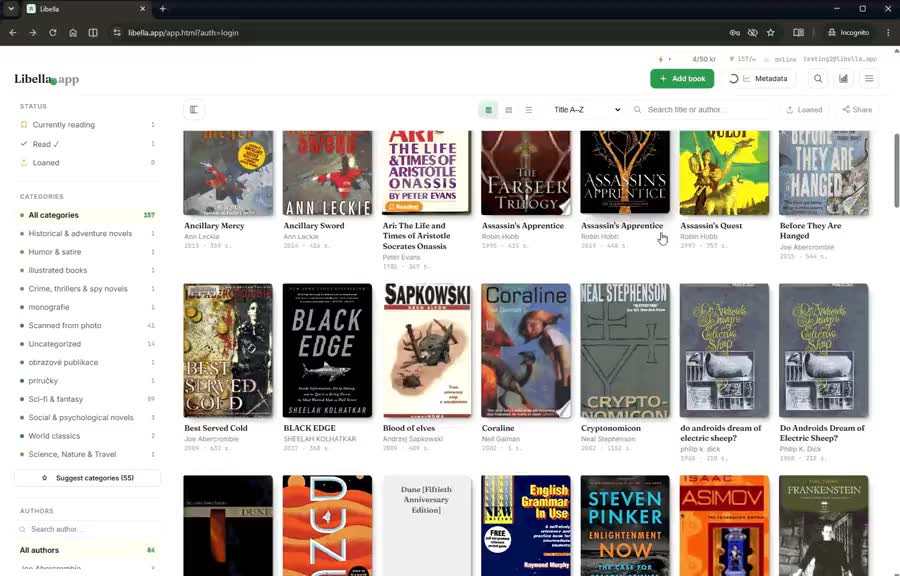
Libella was built for exactly this kind of job. Photograph a shelf and it recognises the books from their spines; scan the barcodes of modern books; photograph the copyright page of older ones and it finds them in national library catalogues across Europe and the US, where old and local editions actually are. When you are done, share the whole library with the family via a link, or save it as a PDF.
Frequently asked questions
How long will it take?
A typical inherited library of a few hundred books can be photographed and catalogued in an afternoon or two. Checking the results and adding the stragglers takes a little longer.
Can family members see the list without an account?
Yes. In Libella you can share your library through a public link that anyone can open, and you can save it as a PDF to email or print.
Is it free?
The first 100 books are free, forever. Shelf photos use AI credits; every new account gets 100 credits, enough for one shelf. Larger libraries need a paid plan (2.99 € a month or 29 € once).
What should I do with inherited books?
Nothing irreversible at first. Photograph the shelves, make a list, let the family choose, check the few books that might be valuable, and only then donate or sell the rest. A list takes an afternoon; a book given away cannot be taken back.
Are inherited books worth anything?
Most are worth more to the family than to a buyer. The exceptions are first editions in good condition, signed copies, books printed before 1900, local history and complete sets. Check sold prices for the exact edition, and ask an antiquarian bookseller about anything that stands out.
Where can I donate an inherited book collection?
Second-hand bookshops, charity shops, library book sales, schools and community libraries. Many no longer take everything, so send them your list first and let them pick what they can use.