"How many books do you have?" is a question every book lover gets asked, and almost nobody knows the answer. Counting by hand is tedious and error-prone: you lose your place, you skip the books lying flat on top, and you forget the box in the attic.
Here are two methods: a quick estimate you can do right now, and an exact count that leaves you with something more useful than a number.
Method 1: the five-minute estimate
All you need is a tape measure. Books are surprisingly consistent in thickness, so shelf length is a good proxy for book count.
- Measure the total length of filled shelf space, in metres or feet. Add up every shelf.
- Count the books on one typical metre (or foot) of shelf.
- Multiply.
As a rough guide, a metre of shelf holds around 30 to 40 hardbacks or 40 to 50 paperbacks; a foot holds roughly 10 to 15. Mixed shelves land somewhere in between, which is why counting your own sample metre beats any rule of thumb.
| Filled shelf space | Rough number of books |
|---|---|
| 5 m (16 ft) | about 150 to 250 |
| 15 m (50 ft) | about 450 to 750 |
| 40 m (130 ft) | about 1,200 to 2,000 |
Method 2: an exact count that is also a catalogue
An estimate answers the question once. A catalogue answers it forever, and also tells you which books you have, which you have read and who borrowed the one that is missing.
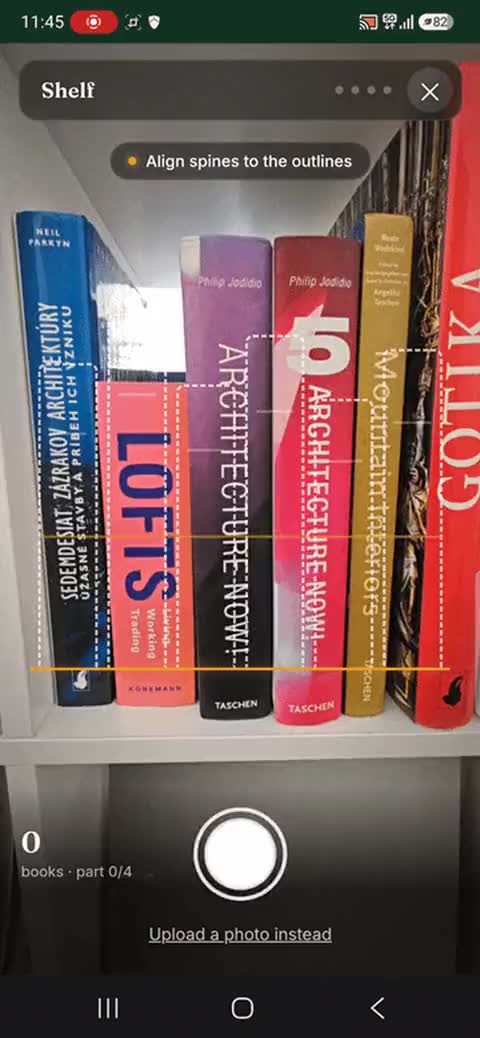
The old way to get there was typing every title into a spreadsheet. The fast way is to photograph your shelves:
- Stand in front of a shelf in good light and take one photo, straight on, so the spines are readable.
- The app reads the spines and adds every book it recognises, with cover, author and year.
- Scan the barcodes of the few books it missed, and photograph the copyright page of old books without an ISBN.
- Repeat shelf by shelf. The total updates as you go.
A typical shelf takes a minute or two this way, so a library of a few hundred books is an afternoon, not a month.
The same method works for a collection you did not build yourself: if you are sorting out a parent's or grandparent's books, see what to do with an inherited book collection.
Counting with Libella
Libella shows the number of books, authors and pages in your library at the top of the screen, and updates them as you add books. You can split the library into shelves (by room, genre or person) and see the totals for each.
- Shelf photo: the AI reads the spines. A free account includes AI credits to try it.
- Barcode scanning and manual entry are always free and do not use credits.
- Old books without an ISBN are found in national library catalogues from a photo of the copyright page.
The first 100 books are free, forever. Above that, Libella costs €2.99 a month or €29 once.
So, how many is a lot?
There is no official answer, but a few hundred books already puts you well above most households, and once you pass a thousand, a catalogue stops being a nice idea and becomes the only way to know what you have. Whatever your number is, it is probably higher than you think.