Look along your shelves and you will see more than titles. Books on faith or doubt, on illness, on politics, on money trouble, on raising a child, on leaving a marriage. A complete list of what someone owns says a good deal about who they are, and it says it quietly, without them ever writing a word about themselves.
That is why the question “where does my list go?” deserves a minute before you start cataloguing.
Five questions to ask any book app
- Who pays for it? Servers, storage and development cost money every month. If you are not paying, someone else is, and it helps to know who.
- Are there ads or trackers? Advertising and analytics scripts from third parties often see what you look at inside the app.
- Is the list private by default? Some book services are social by design: your shelves are visible unless you hide them.
- What happens to photos and text sent to AI? If the app reads your shelves or pages with AI, check whether that data may be used to train models.
- Can you leave with your data? A full export, and an account deletion that really deletes, are the minimum.
A quick checklist
| Check | Good sign | Warning sign |
|---|---|---|
| Business model | You pay, or the free tier is clearly limited | Free with no visible way the service earns money |
| Ads and trackers | None, stated in the privacy policy | Advertising partners listed in the policy |
| Visibility | Private unless you share | Public profile by default |
| AI | Says plainly whether your data trains models | Silent about it |
| Leaving | Export to CSV, delete account in one step | Export hidden or missing |
How Libella handles your data
We would rather tell you exactly than promise vaguely, so here is the whole picture.
- No ads, no third-party trackers. There is no advertising and no analytics or tracking script from another company in the app or on our website.
- We do not sell or share your list. Your catalogue is not passed to advertisers or data brokers, and it is not used for marketing.
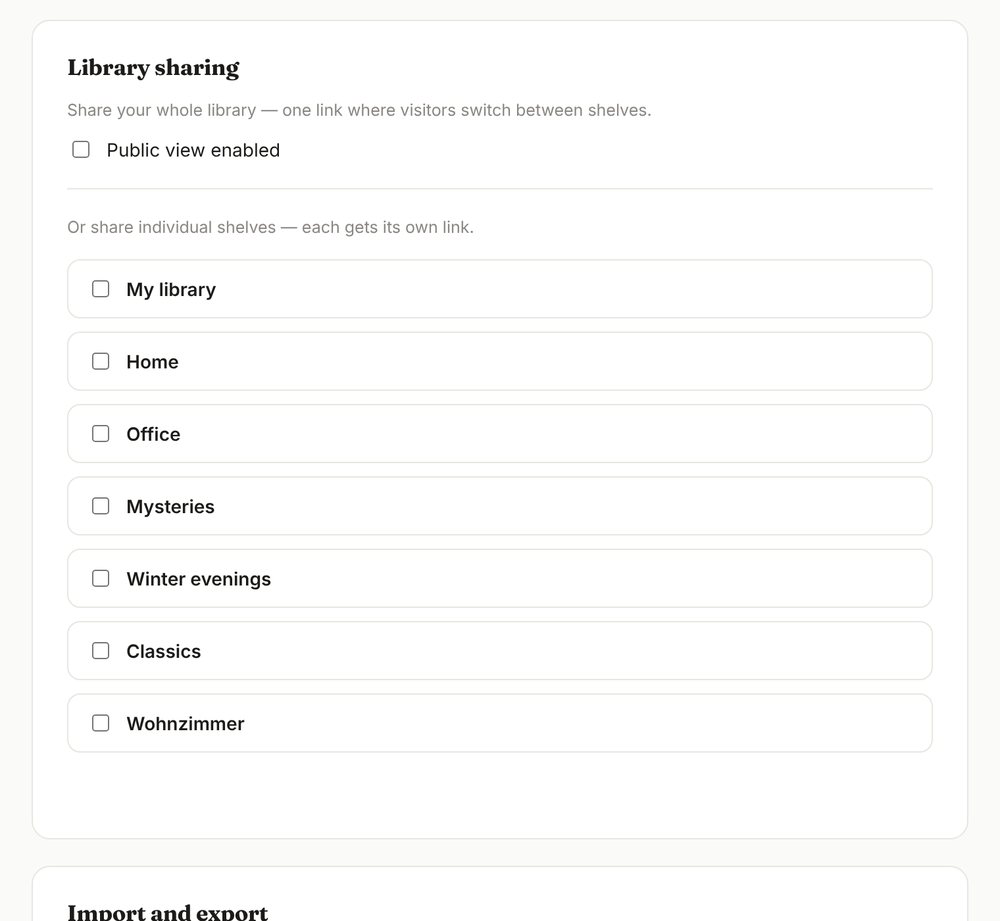
- Private by default. Nobody sees your library unless you switch on a public link yourself, for one shelf or for the whole library, and you can switch it off again.
- Looking up a book sends only the book. When you scan or search, Libella asks national library catalogues, Open Library and Google Books about that ISBN or title. They learn which book is being looked up, not who you are.
- AI features, said plainly. When you photograph a shelf or a copyright page, the photo is sent to Google's Gemini API to read the text. We use the paid API, and under Google's terms for it, that data is not used to train their models. If you never use the AI features, no photo leaves your device. Smaller helpers, such as suggesting genres or writing a missing description, send only the titles and authors concerned to the same API — never your notes, loans or anything else about you.
- Covers you upload. If you add your own cover photo for a book and it is approved for the shared cover catalogue, it is kept there without any link to your account, so other people's copies of the same edition can show it.
- You can leave at any time. Save your catalogue as a PDF whenever you like; export to CSV and JSON is part of the paid plans. Deleting your account removes the account and your private library.
- Run from the EU, under the GDPR. Our privacy policy lists every service we use and what each one does.
Why Libella is not completely free
Keeping a library catalogue running for years costs money: servers, storage, the bridge to national library catalogues, and the people who build it. We chose the simplest way to pay for that: you pay us, not advertisers. That is what lets us keep your list out of anyone else's hands, and it means the app does not depend on finding someone to buy attention.
The first 100 books are free, forever. Above that, Libella costs €29 once, or Libella AI at €2.99 a month, billed yearly (€35.88).
Frequently asked questions
Can other people see my library?
Only if you create a public link. Without one, your catalogue is visible only to you when you are signed in.
Does Libella use my photos to train AI?
No. Shelf and page photos go to Google's paid Gemini API only to read the text, and under its terms that data is not used for training. Barcode scanning, search and library lookups work without AI.
What happens to my data if I delete my account?
The account and your private library are deleted. Export a copy first if you want to keep your list.
Which other apps should I compare?
See our comparison of Libib, LibraryThing, CLZ Books and Libella, and read each app's privacy policy with the five questions above in mind.