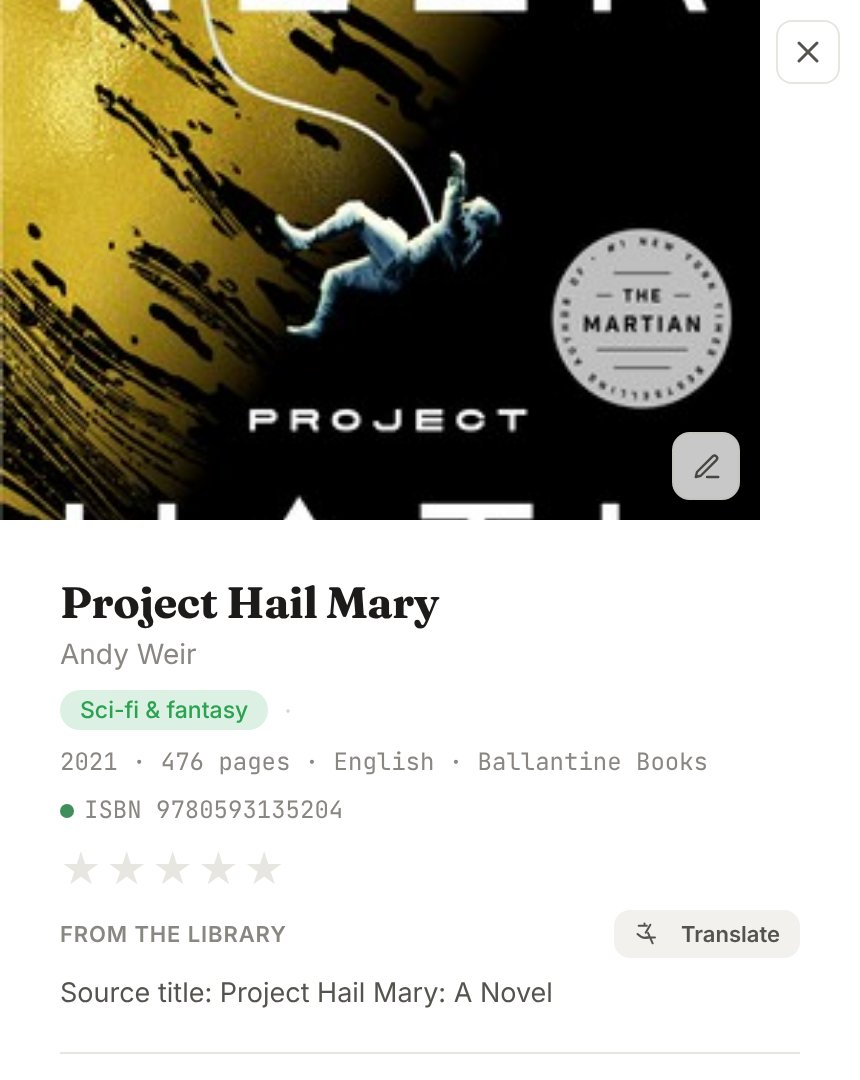
Same title, different book
Take The Hobbit. The first edition appeared in 1937. In 1951 Tolkien revised the chapter Riddles in the Dark so that Gollum's story would fit The Lord of the Rings. Two copies with the same title, author and cover art can therefore contain a different text. Translations multiply the problem. In German alone the book has appeared as Kleiner Hobbit und der große Zauberer (Walter Scherf, Paulus Verlag, 1957), as Der kleine Hobbit (Scherf's revised translation, Georg Bitter Verlag, 1971) and as Der Hobbit in Wolfgang Krege's new translation for Klett-Cotta in the late 1990s: three titles, three publishers, different wording and page counts.
That does not mean every edition has a different text; most reissues change nothing. It means that without the edition details you cannot tell.
For a reading log, these are one book. For a catalogue of what you own, they are different editions, and the difference matters the day you want to know what a copy is worth, whether you already have the translation a friend recommends, or what exactly your grandfather left you.
What identifies an edition
- Publisher and place: the strongest clue for older books.
- Year: of this edition, not of the first publication of the work.
- ISBN, for books printed since the 1970s: separate editions and formats generally get their own.
- Translator and language: a translation is its own edition.
- Page count and format: helps tell a paperback reissue from the original hardback.
Almost all of it is printed on the copyright page, the back of the title page. The cover is the least reliable part of a book: publishers redesign covers without changing the text and reuse a famous cover for a new edition.
Where automatic cataloguing goes wrong
A common approach is: recognise a title, search a database, take the first result. That is fast and often fine for a new bestseller. It fails in predictable ways:
- the first result is the newest edition, not the one you own;
- an English record is taken for a translated copy;
- a book with the same title by a different author slips in;
- an old book that a commercial database never knew gets a modern reissue's year, publisher and cover.
The catalogue looks complete, but some records describe books that are not on your shelf.
A wrong record is worse than an empty one, because you stop checking it.
Work, edition and copy are not the same
Librarians distinguish three levels:
- The work is the content itself: The Hobbit by J. R. R. Tolkien.
- The edition is one published form of it: a German translation, a French one, a new English edition.
- The copy is the physical book on your shelf, with its own binding, inscription, signature or a previous owner's notes.
A reading log only needs the work. A catalogue of your collection needs the edition, and for special books also what makes your copy special. Libella records books at edition level; an inscription or the condition of your copy can go in the book's notes.
How Libella approaches it
We treat recognising a book as the start of the work, not the result.
- With an ISBN, we require a match on the identifier of that specific edition (ISBN-10 or ISBN-13), not just a similar title and author. A record with a different ISBN is discarded: a different book is worse than no book.
- Without an ISBN (shelf photo, title search), several candidates are fetched and the best one is chosen by agreement of title, author and language, not by whichever comes first. A known publisher (from the spine, the copyright page or typed in) first picks the country and the library, then the record from that publisher. If the library only has another edition, the record is marked “edition unconfirmed”, with a shortcut to scan the barcode or the copyright page.
- The right library first. The ISBN group or the language of the title decides which national library is asked first: the Deutsche Nationalbibliothek for a German book, the BnF for a French one, OPAC SBN for an Italian one, among 24 national, university and union catalogues in Europe and the US. Through legal deposit, national libraries collect a large share of what is published in their country, including titles long out of print.
- The copyright page has the last word. Photograph it and Libella reads the publisher, year, page count, series and volume number and the translator. Where the catalogue differs (a library may list 293 pages where your copy has 296), the copyright page wins, because it describes the book in your hands.
- Series and translator are part of the record. Tap a series to see all your books in it, sorted by volume number, and search by translator to find every book they translated.
- Nothing goes straight in from a shelf photo. Recognised books land on a To consider shelf for checking first (see below).
After the photo: always check
Reading books from a photo is never 100 per cent: spines are narrow, worn or at an angle, and glare hides letters. So a shelf photo in Libella starts a short workflow: recognised books land on the To consider shelf, you check each one against the book, correct what is wrong (or scan the barcode to pin the exact edition), and only then move them to your library. The whole process is described in how to scan your bookshelf with your phone.
How to identify the edition you own
- Open the copyright page and note publisher, place, year, edition statement (“Second edition”, “Revised”), translator and ISBN if there is one.
- Search the national library of the country where the book was published: the Library of Congress, the British Library, the Deutsche Nationalbibliothek, the BnF. Search by title and publisher rather than title alone.
- Compare publisher, year, translator and page count with the record. Together, these details confirm whether it is your edition.
- Record the edition, not just the work: publisher, year and translator in your catalogue save you the search next time.
For books printed before ISBNs existed, see our guide to cataloguing old books without an ISBN, or try the free ISBN lookup in national library catalogues for books that have one.
Frequently asked questions
Is the first edition the same as the first printing?
Not always. An edition is a version of the text and layout; printings (impressions) are print runs of that edition. Collectors care about the first printing of the first edition, which is usually stated or coded on the copyright page.
Does every edition have its own ISBN?
Since the ISBN system became established in the 1970s, separate editions and formats (hardback, paperback, ebook) have generally received their own ISBN. Reprints of the same edition usually keep it, and minor corrections do not get a new one.
Why do different databases show different years for the same book?
Often one shows the year the work first appeared and another the year of the edition, or a database has merged several editions into one record. National library records describe a specific edition, which is why they are the safest reference.